
Mahavatar Narsimha (2025): A Grand Indian Animated Mythological Epic
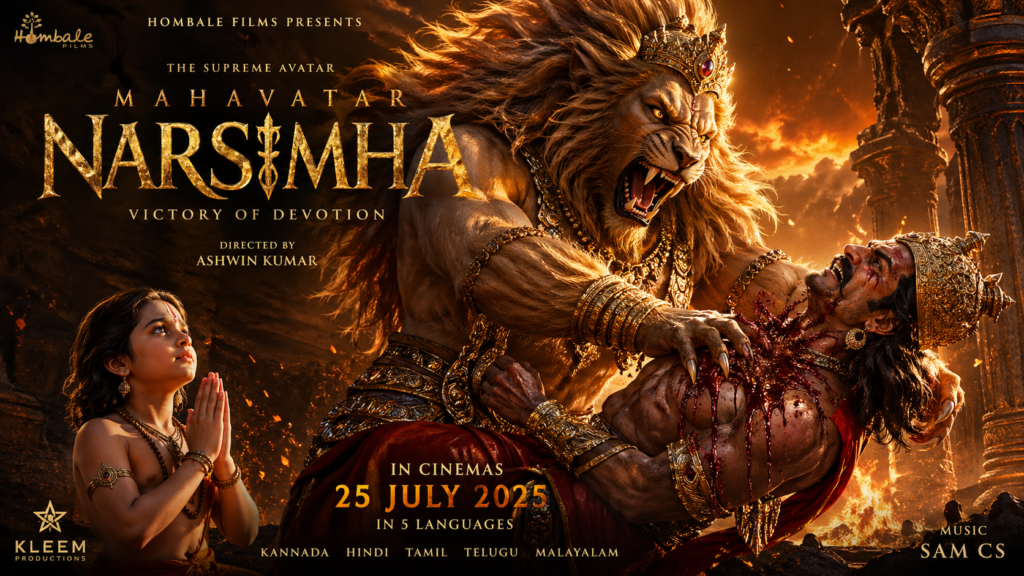
Mahavatar Narsimha (2025) is a landmark Indian animated mythological action film directed by Ashwin Kumar. Released on 25 July 2025 in India, the film brings one of the most powerful stories from Hindu mythology to life in a large-scale 3D animated format. Produced by Kleem Productions and presented by Hombale Films, it stands as one of the most ambitious animated projects ever made in Indian cinema.
The film retells the legendary story of Lord Vishnu’s fourth avatar, Narasimha, the half-man and half-lion form who appears to defeat the demon king Hiranyakashipu and protect his devotee Prahlad. With strong mythological roots and modern visual execution, the film aims to connect ancient storytelling with contemporary cinematic technology.
Story and Mythological Background
The narrative is inspired mainly by the Bhagavata Purana and Narasimha Purana. It follows Hiranyakashipu, a powerful demon king who gains a boon that makes him almost invincible. Over time, his ego grows, and he declares himself a god, demanding worship from everyone in his kingdom.
However, his son Prahlad remains deeply devoted to Lord Vishnu. Despite repeated attempts to punish or kill him, Prahlad’s faith remains unshaken. This conflict between devotion and arrogance forms the emotional core of the story.
To restore balance, Lord Vishnu appears in his fierce avatar as Narasimha, a half-man, half-lion form. He arrives at twilight, on the threshold of a doorway, and defeats Hiranyakashipu in a way that fulfills all conditions of the boon, symbolizing the victory of divine justice over ego and tyranny.
The film also briefly explores the Varaha avatar, expanding its mythological universe and connecting multiple divine incarnations.
Direction and Production Vision
Directed by Ashwin Kumar, the film was created with the vision of elevating Indian animation to global standards. The director aimed to prove that animation is not limited to children’s entertainment but can also deliver powerful epic storytelling for all age groups.
The project is backed by Kleem Productions and Hombale Films, known for large-scale cinematic ventures. Their involvement ensured strong production values, advanced animation technology, and a cinematic presentation that matches international standards.
The film is also the first installment in a planned seven-part Mahavatar Cinematic Universe, designed to explore different avatars of Lord Vishnu in future films.
Animation Style and Technical Quality
One of the most striking aspects of Mahavatar Narsimha is its high-end 3D animation. The film moves away from traditional stylized animation and instead focuses on a more realistic and cinematic visual approach.
Character designs are detailed, environments are richly built, and battle sequences are crafted with a strong sense of scale and intensity. The transformation of Narasimha and the final confrontation scene are among the most visually powerful moments in the film.
The animation style reflects a clear attempt to position Indian animated films in a more global, premium category.
Music and Sound Design
The music is composed by Sam CS, whose background score plays a major role in shaping the emotional tone of the film. The soundtrack blends devotional elements with intense orchestration, enhancing both spiritual and action-driven scenes.
From calm, devotional sequences featuring Prahlad to powerful and aggressive themes during Narasimha’s appearance, the music adds depth and emotional weight throughout the film.
Reception and Audience Response
The film received generally positive feedback for its ambition and execution. Viewers and critics appreciated:
- High-quality 3D animation
- Strong background score
- Faithful mythological adaptation
- Grand visual storytelling
At the same time, some criticism was directed at the intense violence and dark tone, which may not be suitable for younger audiences. Despite this, it is widely considered a milestone in Indian animated cinema.
Cultural and Industry Impact
Mahavatar Narsimha represents a significant step forward for Indian animation. It challenges the long-standing perception that animation is primarily for children and instead positions it as a medium capable of delivering epic mythological narratives.
The film also strengthens the trend of building mythology-based cinematic universes in India, opening doors for large-scale storytelling similar to global franchise models.
By combining spiritual themes with advanced technology, the film creates a unique space where tradition meets innovation.
Mahavatar Cinematic Universe
The film is officially the first chapter in the Mahavatar Cinematic Universe, a planned seven-part series based on the different avatars of Lord Vishnu.
Each installment is expected to explore new stories, characters, and mythological events, gradually building a connected universe rooted in Indian scriptures.
Upcoming Related Project
Alongside this animated epic, another project titled “Mahavatar” (2026) is also in development. Directed by Amar Kaushik, the film is expected to be a live-action mythological feature starring Vicky Kaushal as Parashurama. While different in format, it further highlights the growing interest in mythological storytelling in Indian cinema.
FAQs
- What is Mahavatar Narsimha (2025) about?
It is an animated mythological film based on Lord Vishnu’s Narasimha avatar, who defeats the demon king Hiranyakashipu to protect his devotee Prahlad.
- Who directed Mahavatar Narsimha?
The film is directed by Ashwin Kumar.
- When was the movie released?
It was released in India on 25 July 2025.
- What is the animation style of the film?
The film uses high-quality 3D animation with a more realistic, cinematic visual approach.
- Is the film suitable for children?
The film contains intense action and violent sequences, so it may not be suitable for very young children.
- Is Mahavatar Narsimha part of a series?
Yes, it is the first installment of the planned seven-part Mahavatar Cinematic Universe.
- Who composed the music of the film?
The music and background score were composed by Sam CS.
- Will there be more films in this universe?
Yes, the makers have planned multiple films based on different avatars of Lord Vishnu in the coming years.
Final Thoughts
Mahavatar Narsimha (2025) stands as a bold and ambitious attempt to redefine Indian animated cinema. With its powerful mythological foundation, advanced 3D animation, and large-scale storytelling, the film pushes the boundaries of what Indian animation can achieve. It successfully brings a deeply spiritual story to life while experimenting with a modern cinematic language.
Though intense in tone, the film leaves a strong impact and sets the foundation for a larger mythological universe. It marks a new direction where Indian animation is no longer limited by expectations, but driven by vision and scale.